Seminar on Nanoparticles by Prof C. Kiparissides @ DTU [14 May 2009]
Seminar om nanopartikler ved professor Costas Kiparissides
14. maj 2009 gæstede professor Costas Kiparissides DTU Kemiteknik med seminaret "New Issues on Population Balance Modeling and Optimization of Particulate Polymerization and Biochemical Systems".
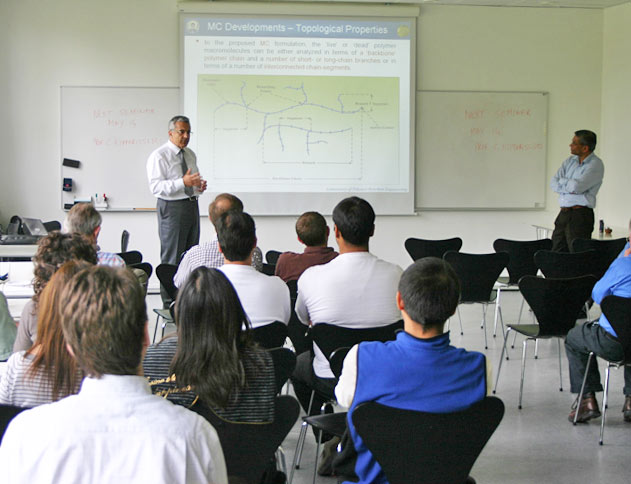
Costas Kiparissides forelæste i DTU Kemitekniks lounge
Costas Kiparissides, der er professor ved Department of Chemical Engineering, Aristotle University of Thessaloniki & Centre for Research and Technology Hellas, Thessaloniki, Grækenland, arbejder med matematisk modellering af partikel processer (population balance equation (PBE)), et område der har utrolig mange potentielle anvendelsemuligheder bl. a. indenfor medicin.
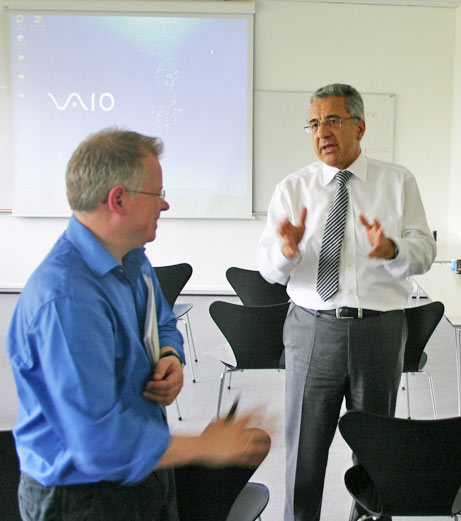
Costas Kiparissides i diskussion med professor John Woodley, DTU Kemiteknik, efter forelæsningen
På det velbesøgte seminar fortalte Costas Kiparissides bl. a. om nye muligheder for behandling af sygomme som aids ved spray af aerosoller gennem næsen. Forskningen er kommet langt mht. computersimulation af kroppens optag af nanopartikler, og Costas Kiparissides vurderer at man om 10-20 år er kommet så langt, ved hjælp af kraftigere computere og bedre programmel, at man med stor præcision vil kunne teste nye medikamenter på computersimulerede menneskelige organer. Disse metoder og den viden de genererer vil som en sidegevinst kunne bruges til at lodde giftigheden af de skadelige nanopartikler, vi omgiver os med i det daglige, fra bl. a. trafik, forurening, rygning mm.
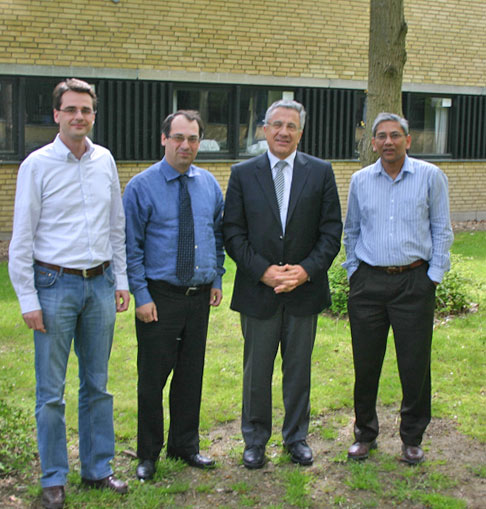
Costas Kiparissides med Rafiqul Gani og Georgios Kontogeorgis efter seminaret.
Abstract:
"New Issues on Population Balance Modeling and Optimization of Particulate Polymerization and Biochemical Systems"
by Professor Costas Kiparissides,
Department of Chemical Engineering,
Aristotle University of Thessaloniki & Centre for Research and Technology Hellas, Thessaloniki, Greece
The dynamic evolution of the PSD in a particulate process is commonly obtained by the solution of a population balance equation (PBE). One-dimensional (univariate) population balance equation models have been employed to describe the evolution of populations of particles, droplets, crystals, cells, etc. in dispersed phase systems. These models assume that the dynamic evolution of the particle population depends only on a single internal variable (usually particle volume or mass) and that all other particle properties are evenly distributed among the population. However, this is often not the case. The need for the employment of a higher dimensional, multivariate PBE model has been noted for a variety of systems such as aerosol systems, granulation processes, cell cultures, extraction columns, etc.
While univariate PBEs can be successfully dealt with a variety of numerical methods, the development of numerical algorithms that enable the accurate determination of multivariate solutions is still considered a challenging task. Several numerical methods have been proposed for solving multi-dimensional PBEs. These include MonteˆCarlo simulations, the method of classes, finite differences, finite elements and spectral methods, the method of moments, EulerˆLagrange and fixed-pivot techniques and Galerkin on finite elements. Needless to say that the identification of the functional forms of particle nucleation, growth, ŒŒdeath'' and ŒŒbirth'' rate terms, appearing in a multi-dimensional PBE, is by no means a trivial task. Consequently, a key challenge in the numerical solution of multivariate PBEs is the reduction of the computational demands while maintaining the accuracy of the solution at acceptable levels.










 Εκτύπωση σελίδας